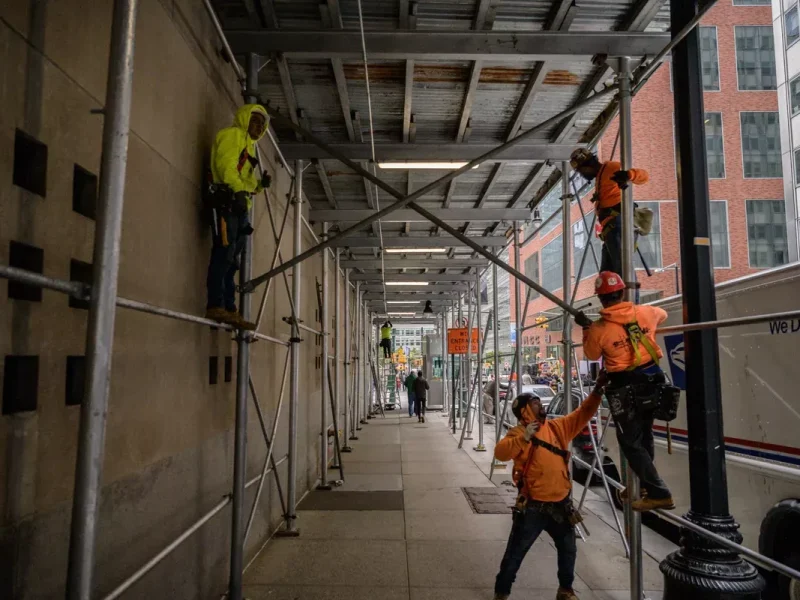
New York City is famous for its iconic skyline, but beneath the towers is a second, less glamorous structure that has quietly become part of the city’s identity: scaffolding. What began as a short-term construction tool has, over the decades, turned into a fixture of nearly every block in Manhattan, Brooklyn, and Queens — and its story is really the story of how NYC learned, the hard way, to take facade safety seriously.
The turning point came in 1979, when a piece of masonry fell from a building on the Upper West Side and killed a Barnard College student walking below. The following year, the City Council responded with Local Law 10 of 1980, the first ordinance requiring regular inspection of building facades taller than six stories. It was a narrow, largely reactive measure — but it planted the legal roots of what scaffolding in New York would become.
Nearly two decades later, in December 1997, a chunk of a building’s side wall on Madison Avenue came loose and crashed to the street below. The near-miss (injuries were minor, but the damage could easily have been fatal) pushed the City to act fast. In March 1998, Mayor Giuliani signed Local Law 11, dramatically expanding the original 1980 law. Local Law 11 required inspection of all exterior walls, not just street-facing ones, and mandated that any building found to have an unsafe condition install protective scaffolding — known locally as a sidewalk shed — until repairs were finished.
That combined framework is known today as FISP: the Facade Inspection & Safety Program. Under FISP, every building in New York City taller than six stories must have its facade inspected by a qualified professional once every five years. If the inspection turns up a hazard, a sidewalk shed goes up immediately to protect pedestrians, and it stays up until the repair is complete and verified.
Why Is Scaffolding Still Covering NYC?
FISP was designed as a public safety measure, not a permanent fixture — yet anyone who has walked through Midtown or Downtown Brooklyn knows that sidewalk sheds have a way of staying up for months, sometimes years, longer than anyone expects. A few forces drive that:
Safety Regulations With Real Teeth
Once a building is classified as “Unsafe” under FISP, the law is unambiguous: protection stays up until the repair is verified complete. That’s the right call for public safety, but it also means a shed’s lifespan is tied directly to how quickly a building owner can execute repairs — not to a fixed calendar.
The Cost of Repairing Old Buildings
Much of NYC’s building stock predates modern facade materials and techniques. Masonry restoration, terra cotta replacement, and structural repointing on a pre-war high-rise can run into the millions. Owners frequently need time to secure financing or coordinate repairs across a large capital improvement plan, and the scaffold simply waits with them.
Permitting and Bureaucratic Timelines
Between DOB filings, architect/engineer sign-offs, and construction permitting, the administrative side of a facade repair can take as long as the physical work itself. Delays anywhere in that chain extend the shed’s stay on the sidewalk.
Deferred Maintenance
Not every owner moves with urgency. Some property owners treat the shed itself as the compliance solution rather than the repair behind it, leaving scaffolding up far past what the law intended as a temporary protective measure.
The scale of the problem is real enough that City Hall has made it a headline issue. Since launching its “Get Sheds Down” initiative in July 2023, the Department of Buildings has removed more than 15,200 sidewalk sheds citywide — including hundreds that had been standing for three years or longer. That the City needed a dedicated, multi-year campaign just to bring the numbers down tells you how deeply scaffolding had become woven into the everyday streetscape, rather than the short-term safety measure the original law envisioned.
The Future of Scaffolding in NYC
Growing public frustration over the number and duration of sidewalk sheds has pushed the issue to the top of the City’s agenda — and unlike past efforts, the changes now underway are already being written into law. In 2024, the Department of Buildings partnered with engineering firm Thornton Tomasetti on the first-ever evidence-based review of FISP, and the results are shaping real policy:
Shorter Permits, Faster Enforcement
Sidewalk shed permits, once valid for a full year, have been cut down to just 90 days — building owners now have to show proof of active progress to renew. The DOB’s Long-Standing Shed Program, which subjects older sheds to stricter court enforcement, now applies to any shed up for three years or more, down from the previous five-year threshold. Starting in 2026, owners also face monthly penalties of up to $6,000 for sheds that sit past 180 days without active work.
All-New Shed Designs
After decades of the same hunter-green pipe-and-plywood shed, the DOB has unveiled six redesigned models developed with architecture firm PAU and engineering firm Arup — including lighter, more open structures with better lighting, taller clearances, and designs that eliminate the tunnel-like feel of traditional sheds. The City expects the first of these to start appearing on sidewalks in 2026.
A Longer Look at Inspection Cycles
Thornton Tomasetti’s study recommended extending the FISP inspection cycle from five years to as long as six to twelve years for buildings in demonstrably good condition, along with piloting drone-based inspections and shifting toward more visual (rather than always hands-on) assessments — changes aimed at reducing unnecessary protective installations without compromising safety.
Continued Political Momentum
New York’s current administration under Mayor Zohran Mamdani has kept the pressure on, pledging the immediate removal of city-owned sheds that have stood for more than three years and pushing DOB to shorten the radius sheds must cover around low-risk buildings. The direction is consistent across administrations: fewer sheds, shorter stays, and designs the public can actually live with.
Conclusion
Scaffolding and sidewalk sheds exist because New York City decided, after real tragedies, that pedestrian safety comes first — and that decision has more than proven itself over the past four decades. But a measure meant to be temporary has, in many cases, become semi-permanent, and the City, building owners, and contractors are all now grappling with how to close that gap without cutting corners on safety.
For property owners and contractors, that means the difference between a shed that goes up for a few weeks and one that lingers for years often comes down to working with a team that treats compliance, permitting, and installation as a coordinated process — not three separate headaches.
Need Scaffolding Done Right the First Time?
At NYC Best Scaffold, we’ve spent decades helping New York City property owners and contractors navigate exactly the challenges outlined above — from FISP-driven sidewalk shed installations to full commercial scaffold projects across Manhattan, Brooklyn, Queens, and Long Island. Our team handles the site evaluation, the code compliance, and the installation itself, so your project moves forward without the shed becoming a permanent fixture on your block.
Contact NYC Best Scaffold today for a complimentary consultation and see how a properly planned, professionally installed scaffold can protect your building — and your timeline.