Queens is New York City’s largest borough by land area, and its construction activity reflects that scale. From the retail corridors of Jamaica and Flushing to the industrial zones of Long Island City and the residential brownstones of Astoria, contractors across Queens face one recurring requirement before any exterior work can begin: a compliant, properly engineered scaffolding system.
Choosing among the many commercial scaffolding companies in Queens is not a decision to make on price alone. The right scaffold rental partner affects worker safety, project timelines, Department of Buildings compliance, and ultimately whether an inspection passes on the first attempt. This guide breaks down what commercial scaffolding actually involves in Queens, the systems available, and how to evaluate a provider before signing a rental agreement.
What Commercial Scaffolding Means in Queens
Commercial scaffolding refers to temporary, engineered access structures used on non-residential and large-scale residential projects — office buildings, retail centers, apartment complexes, warehouses, and institutional properties. Unlike lighter-duty residential setups, commercial scaffolding must support heavier material loads, larger crews working across multiple levels simultaneously, and longer project durations.
Queens presents a particularly diverse set of site conditions. A facade restoration on a pre-war building in Forest Hills has different structural and access requirements than a new-construction mixed-use development in Long Island City, or a warehouse renovation in Maspeth. A qualified scaffolding contractor evaluates the building type, site footprint, and pedestrian traffic before recommending a scaffold configuration — not after the equipment has already arrived on-site.
Common Scaffold Types Used on Queens Job Sites
Frame Scaffolding
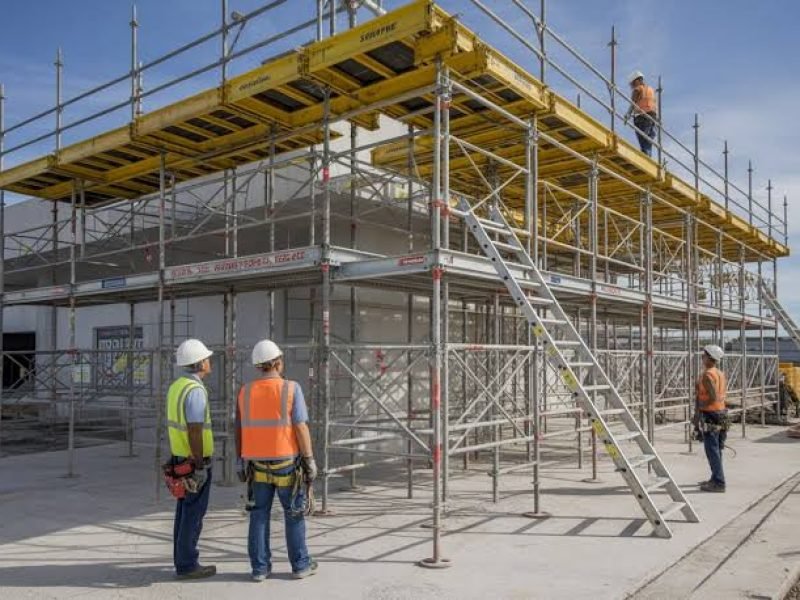
Frame scaffolding is the most widely used system for general commercial construction and renovation work. It is modular, quick to assemble, and cost-effective for mid-rise buildings, making it a common choice across Queens’ retail strips and multi-family properties.
Suspended Scaffolding
For taller commercial structures, particularly facade work and window cleaning on high-rise buildings, suspended scaffolding provides a platform that hangs from the roof or an overhead structure. This system is common in denser commercial corridors where ground-level space is limited.
System Scaffolding
System scaffolding offers greater load capacity and configuration flexibility, making it suitable for complex commercial builds with irregular building shapes or heavier material demands. Contractors managing larger developments in areas like Long Island City often require this level of adaptability.
Sidewalk Sheds
Any project adjacent to a public sidewalk in Queens typically requires a protective overhead structure to shield pedestrians from falling debris. These structures are distinct from access scaffolding and are governed by their own DOB requirements. Property owners planning exterior work should understand how sidewalk shed installation fits into the broader project timeline, since it is often the first structure erected and the last one removed.
Permits and Compliance for Scaffolding in Queens
New York City’s Department of Buildings regulates scaffolding under strict guidelines, and Queens is no exception. Any commercial scaffold erection typically requires a permit, and the structure must meet load, anchoring, and inspection standards set by both the DOB and OSHA.
Key compliance factors contractors and property owners should confirm with their scaffolding provider include:
- Permit filing and expediting. A reputable provider handles or assists with DOB permit filings rather than leaving the property owner to navigate the process alone.
- Engineering sign-off. Certain scaffold configurations, particularly suspended and system scaffolding on taller structures, require a licensed engineer’s approval.
- Routine inspections. Scaffolding must be inspected regularly throughout the rental period, not just at installation, to remain compliant and safe.
- Insurance and liability coverage. Given the density of pedestrian traffic in commercial areas of Queens, adequate liability insurance from the scaffolding company protects both the contractor and the property owner.
Skipping any of these steps risks stop-work orders, fines, or — more importantly — safety incidents. A provider experienced with scaffolding companies Queens projects should be able to walk through this process clearly before work begins.
What to Look for in a Queens Scaffolding Company
Equipment Quality and Inventory Depth
Not every provider stocks the full range of frame, suspended, and system scaffolding. A company with a deep inventory can match the correct system to the project rather than forcing a one-size-fits-all setup. Ask about equipment age, inspection records, and maintenance practices before committing.
Installation and Dismantling Expertise
Improper installation is one of the leading causes of scaffold-related incidents. Experienced crews follow strict sequencing and anchoring protocols, and they dismantle the structure efficiently once work concludes — leaving the site clean and free of hazards. This is especially important on active commercial sites where downtime carries a direct cost.
Rental Flexibility
Commercial projects rarely run on fixed timelines. Delays from weather, material delivery, or inspection scheduling are common. A scaffolding provider offering flexible short- and long-term rental agreements, without punitive extension fees, reduces financial risk for the property owner or general contractor.
Responsive Communication
Construction sites generate questions daily — about load capacity, additional sections, or unexpected site conditions. A provider with responsive support staff prevents small issues from becoming schedule-altering delays.
Local Familiarity
A company that regularly works across Queens neighborhoods understands borough-specific factors: narrow lot lines in Astoria, high pedestrian volume near transit hubs in Flushing, and industrial-scale requirements in Maspeth and Long Island City. That familiarity often translates into faster permitting and fewer on-site surprises.
Commercial Scaffolding Queens vs. Other NYC Boroughs
While the core principles of commercial scaffolding remain consistent citywide, site conditions vary meaningfully by borough. Contractors comparing providers may notice that companies also serving commercial scaffolding in Brooklyn or commercial scaffolding in Manhattan bring broader logistical experience — particularly around dense-block installation and DOB filing speed — that can benefit Queens projects as well. Providers with multi-borough experience, including work in the Bronx, tend to have more mature safety and compliance systems simply because they’ve encountered a wider range of site conditions.
Environmental and Cost Considerations
Sustainability has become a more visible factor in commercial construction decisions. Providers that minimize material waste, reuse components across projects, and maintain equipment properly rather than replacing it prematurely contribute to a lower environmental footprint without sacrificing structural integrity.
On the cost side, competitive pricing should never come at the expense of safety documentation, insurance coverage, or inspection frequency. The lowest quote is rarely the lowest total cost once permit delays, re-inspections, or safety citations are factored in. Property owners and general contractors should request an itemized quote that clearly states what is included — installation, inspection, dismantling, and permit assistance — rather than a single bundled number.
Final Thoughts on Choosing a Queens Scaffolding Partner
Commercial scaffolding is infrastructure, not decoration. It protects workers, protects the public, and keeps a project moving toward its completion date without regulatory interruptions. For contractors and property owners across Queens — whether managing a facade restoration in Forest Hills, a retail buildout in Jamaica, or a new development in Long Island City — the scaffolding provider selected at the outset shapes the safety and efficiency of everything that follows.
Before signing a rental agreement, confirm the provider’s equipment range, permit-handling process, insurance coverage, and local project experience. A company that treats these as standard practice, not an upsell, is the one worth building with.
For projects requiring full setup support, from initial scaffolding installation through final dismantling, working with an experienced commercial scaffolding provider in Queens from day one removes much of the guesswork from the process — and keeps the project focused on what matters: getting the work done safely and on schedule.