How to Choose the Right Contractor
Queens is one of New York City’s most active construction corridors. From Flushing high-rises to Jamaica mixed-use developments, every major project depends on one critical infrastructure element: a properly engineered commercial scaffolding system.
Yet most property owners, general contractors, and project managers treat scaffolding as an afterthought — a commodity rental rather than a structural decision. That gap in thinking costs time, money, and in worst cases, lives. This guide covers everything you need to know about commercial scaffolding in Queens: the scaffold types in active use, the NYC Department of Buildings (DOB) compliance requirements, realistic cost structures, and the selection criteria that separate a qualified scaffolding contractor from an underprepared one.
What Is Commercial Scaffolding and Why Does It Differ from Residential?
Commercial scaffolding refers to temporary elevated work platforms used on structures intended for business, institutional, or multi-unit occupancy — office buildings, retail centers, hotels, warehouses, and mixed-use towers. The distinction from residential scaffolding is not merely scale; it is load capacity, duration, and regulatory exposure.
A commercial project in Queens may require a scaffold system to support multiple trades simultaneously — ironworkers, glaziers, facade repair crews — along with heavy tools and materials. This demands engineered frame scaffolding or modular system scaffolding rated for distributed loads exceeding 50 lbs per square foot. Residential scaffolding rarely operates under those constraints.
Scaffold System Types Used in Queens Commercial Projects
Choosing the correct scaffold system is an engineering decision, not a preference. The three dominant systems deployed across Queens commercial sites each serve distinct project contexts.
| Scaffold Type | Best Application | Load Capacity | Typical Rental Duration |
|---|---|---|---|
| Frame Scaffolding | Exterior masonry, facade repair, painting | Medium–High | Weeks to months |
| Suspended Scaffolding | High-rise curtain wall, window replacement | Light–Medium | Long-term, ongoing access |
| System Scaffolding | Complex geometry, industrial, large-scale construction | Very High | Multi-month to multi-year |
Frame Scaffolding
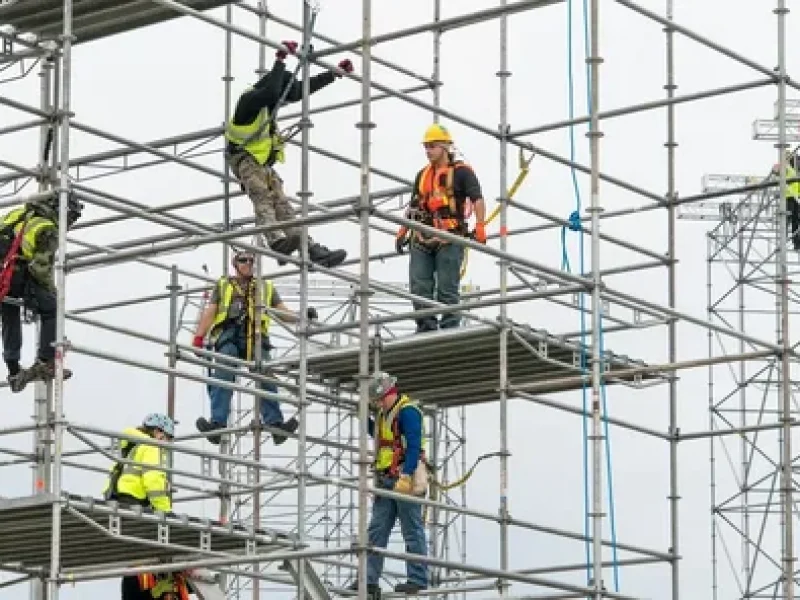
Frame scaffolding — also called tube-and-coupler or sectional scaffolding — is the most widely used system in Queens commercial construction. Its modular panels allow rapid assembly along standard building facades and accommodate both light finishing work and heavy masonry tasks. Certified scaffolding installers must verify that all cross-braces, base plates, and mudsills are properly positioned before any crew ascends.
Suspended Scaffolding
Suspended scaffold systems hang from roof-mounted davit arms or outrigger beams, giving workers continuous vertical access on high-rise glass and curtain wall projects. In a dense borough like Queens — where ground clearance is limited and pedestrian sidewalk sheds are required — suspended systems minimize street-level disruption while maintaining DOB-compliant worker access.
System Scaffolding
System scaffolding (ringlock or cuplock configurations) is the standard for large-scale new construction and industrial facilities. Its pre-engineered connections eliminate loose hardware, reduce erection time, and provide predictable load paths — critical when multi-trade work is occurring simultaneously at different scaffold tiers.
NYC Compliance: What Every Queens Scaffolding Contractor Must Meet
Commercial scaffolding in Queens operates under overlapping regulatory frameworks: OSHA 29 CFR 1926 Subpart Q (federal scaffold safety standards), NYC Building Code Chapter 33 (safeguards during construction), and DOB permit requirements for any scaffold over 40 feet or within the public right-of-way.
A licensed scaffolding contractor must hold a NYC Supported Scaffold User Permit (SSUP) or Supported Scaffold Supervisor License (SSSL) for the relevant scope of work. Before selecting any scaffolding company in Queens, verify their DOB license status through the NYC Buildings Information System. Unlicensed operators expose general contractors to stop-work orders, fines, and liability in the event of worker injury.
Understanding Commercial Scaffold Rental Costs in Queens
Scaffold rental pricing in Queens is structured around three cost centers: equipment rental, installation/dismantling labor, and permit fees. Equipment rental for frame scaffolding typically runs on a per-linear-foot-per-month basis, while system scaffolding is often priced per ton of equipment deployed.
For a mid-size Queens commercial facade project covering 5,000 square feet, total scaffold rental and installation costs commonly range from $18,000 to $65,000, depending on height, site complexity, and rental duration. Contractors offering significantly lower quotes often exclude permit filing fees, engineering stamps, or after-hours dismantling — costs that surface later and inflate the final invoice.
Reputable scaffolding companies in Queens provide itemized proposals that separate equipment, labor, permits, and any sidewalk shed components into distinct line items. Transparent pricing structures protect both the project budget and the contractor relationship throughout the build.
How to Evaluate a Commercial Scaffolding Company in Queens
Beyond license verification, evaluate prospective scaffolding contractors across four dimensions: safety record (OSHA 300 logs and EMR rating), equipment inventory quality (age, inspection records, brand specifications), project management capacity (dedicated foreman, communication protocols), and post-installation support (24/7 availability for emergency adjustments).
The best commercial scaffolding companies operating in Queens combine engineering expertise with local site knowledge — understanding borough-specific access constraints, DOB inspector relationships, and the logistical demands of working in active commercial corridors like Jamaica Avenue, Long Island City, or downtown Flushing.
Commercial scaffolding in Queens is a technical discipline, not a transactional commodity. The right scaffold system, properly installed by a licensed contractor and maintained in compliance with NYC DOB standards, protects workers, safeguards the public, and keeps your project on schedule. When evaluating scaffolding companies in Queens, prioritize safety credentials, transparent pricing, and demonstrated experience on commercial-scale projects — the cost of cutting corners far exceeds the cost of choosing correctly from the start.