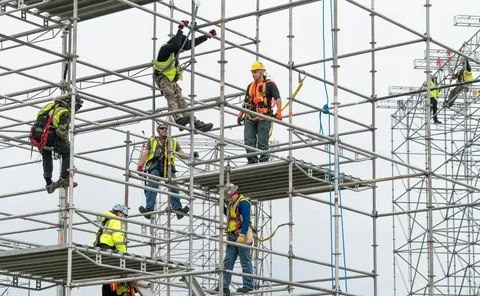
From Long Island City mixed-use towers to Flushing commercial facades and Jamaica retail renovation — Queens demands a scaffolding partner who understands its architecture, regulations, and pace.
NYC Best Scaffold EditorialQueens Borough Guide~1,100 words2025 Edition
Queens is New York City’s most architecturally diverse borough — a landscape of mid-century residential blocks, modern high-rise towers, historic commercial corridors, and light-industrial campuses, all evolving simultaneously. For contractors, developers, and property managers working in this environment, commercial scaffolding in Queens is not a simple logistics task. It is a precision operation that requires deep knowledge of borough-specific building codes, DOB permitting workflows, neighborhood access constraints, and the structural demands of commercial-grade construction.
This guide covers every dimension of commercial scaffolding in Queens: the types of scaffold systems deployed on commercial sites, the regulatory environment that governs their use, the unique characteristics of Queens as a construction geography, and the qualities that define a reliable scaffolding partner in this borough.
What Is Commercial Scaffolding in Queens?
Commercial scaffolding refers to elevated access structures installed specifically to support construction, renovation, facade repair, and exterior maintenance on commercial properties — office buildings, retail centers, mixed-use developments, hotels, warehouses, and industrial facilities. Unlike residential scaffolding, commercial installations typically require higher load ratings, longer operational durations, greater horizontal coverage, and stricter engineering documentation.
In Queens specifically, commercial scaffolding projects span a wide spectrum: a suspended scaffold system for curtain wall replacement on a Long Island City high-rise operates under entirely different constraints than a frame scaffold erected for exterior painting on a Jamaica Avenue retail block. A qualified commercial scaffolding provider in Queens must be capable of engineering, permitting, and executing across this full range of project types.
Commercial Scaffold Systems Used in Queens
NYC Best Scaffold deploys five primary scaffold system types across Queens commercial projects, each selected based on building height, facade complexity, project duration, and site access conditions.
Frame Scaffolding
Standard H-frame systems for low-to-mid-rise commercial buildings. Fast assembly, strong load capacity, ideal for exterior cladding, painting, and window replacement on 3–10 story structures.
System Scaffolding
Modular, engineered platforms for complex facades and large commercial footprints. Used on Queens mixed-use developments requiring multi-bay, multi-story access with load-rated working decks.
Suspended Scaffolding
Motorized and manually operated platforms suspended from building rooftops. The preferred solution for high-rise facade restoration, caulking, and window work in Long Island City and Downtown Flushing.
Pipe & Coupler Scaffolding
Maximum configuration flexibility for irregular building geometries, corner wraps, and non-standard facades common in Queens’ older commercial corridors along Northern Boulevard and Queens Boulevard.
Sidewalk Sheds
DOB-mandated pedestrian protection for commercial buildings undergoing facade repair or Local Law 11 inspection. Protects pedestrians on high-traffic Queens commercial streets during active work.
Support Scaffolding
Heavy-duty shoring and support systems for structural work, slab replacement, and load-transfer applications on Queens commercial construction and deep renovation projects.
Queens Commercial Districts: What Each Zone Demands
Queens is not a monolithic construction market. Each commercial district carries its own set of logistical constraints, architectural typologies, and regulatory considerations that directly shape how scaffolding projects are designed and managed.
Long Island City
The most rapidly developing commercial zone in Queens, Long Island City hosts a dense concentration of new high-rise construction, hotel conversions, and office tower facade projects. Scaffolding on these sites typically involves system or suspended scaffold systems with strict crane-lift and street-closure coordination requirements. NYC Best Scaffold’s experience with high-density, fast-timeline commercial projects is especially relevant here.
Flushing
Flushing’s commercial core along Main Street and Roosevelt Avenue features high pedestrian density, multilevel retail structures, and a mixture of older commercial buildings requiring facade repair under Local Law 11 and newer mixed-use developments in active construction. Sidewalk shed installations on Flushing’s main commercial corridors require careful pedestrian management planning and tight dimensional compliance to maintain sidewalk clearance.
Jamaica & Southeast Queens
Jamaica serves as the commercial hub of southeast Queens, with ongoing retail development, transit-oriented construction near Jamaica Station, and a significant stock of older commercial buildings approaching Local Law 11 inspection deadlines. Frame and system scaffolding predominate here, typically on three-to-eight story structures. NYC Best Scaffold has built a strong operational presence across Jamaica and the surrounding neighborhoods of Hollis, Springfield Gardens, and St. Albans.
NYC Regulations Governing Commercial Scaffolding in Queens
Commercial scaffolding projects in Queens are subject to an overlapping framework of federal, state, and municipal regulations. Compliance is non-negotiable — violations result in stop-work orders, DOB fines, insurance complications, and project delays that can cascade across an entire construction timeline.
- OSHA 29 CFR 1926 Subpart L — federal scaffold safety standards covering load ratings, fall protection, access ladders, and guardrail requirements on all commercial scaffold platforms
- NYC Construction Code Chapter 33 — city-level site safety regulations including mandatory safety plan submission, construction superintendent requirements, and uniform standpipe identification
- Local Law 11 / Facade Inspection Safety Program (FISP) — requires buildings over six stories to undergo facade inspection every five years; most FISP repairs trigger commercial scaffold and sidewalk shed installation
- NYC DOB Scaffold Permit (PW1 / Scaffold Application) — required before installation of any supported or suspended scaffold on a commercial property; contractor must be DOB-registered
- Queens Community Board Coordination — large scaffold installations affecting Queens commercial corridors may require community board notification and coordination with local business improvement districts
- FDNY Site Safety Protocols — scaffolding adjacent to sprinkler and standpipe systems must comply with FDNY access and identification requirements
NYC Best Scaffold manages the entire regulatory compliance process — from initial permit application and structural engineering submission through final DOB sign-off and safe scaffold removal — ensuring Queens commercial clients are never exposed to compliance risk during active projects.
Why Commercial Scaffolding in Queens Requires Local Expertise
Queens presents a set of logistical and regulatory challenges that are distinct from other NYC boroughs. Understanding them before mobilization is what separates efficient scaffold projects from costly, delayed ones.
Historic preservation considerations
Several Queens commercial corridors — including sections of Astoria, Forest Hills Gardens, and Jamaica — include structures with landmark or historic preservation designations. Commercial scaffolding on or adjacent to these properties requires Landmarks Preservation Commission coordination and, in some cases, specially designed scaffold systems that avoid altering the character of protected facades during installation.
Narrow commercial streets and high pedestrian volume
Queens’ commercial streets — particularly in Flushing, Jackson Heights, and Astoria — combine narrow sidewalks with very high pedestrian volumes from transit commuters and retail shoppers. Sidewalk shed and scaffold installations on these corridors require detailed pedestrian flow planning to maintain safe walkway clearance while protecting public safety and supporting surrounding business continuity.
Mixed residential-commercial zoning
Queens features extensive mixed-use and transitional zoning where commercial scaffolding projects operate immediately adjacent to occupied residential units. This proximity imposes noise, access, and scheduling constraints that require experienced project management. NYC Best Scaffold coordinates directly with property managers, tenants, and GCs to minimize disruption to adjacent occupied spaces throughout the scaffold’s operational lifecycle.
How to Choose a Commercial Scaffolding Company in Queens
With multiple scaffolding contractors operating across Queens, the selection decision carries real consequence for project safety, schedule, and budget. These criteria define the difference between a reliable commercial partner and a risk exposure.
DOB registration and OSHA certification. Any commercial scaffolding contractor operating in Queens must be registered with the NYC Department of Buildings and demonstrate current OSHA compliance. Ask for certification documentation before signing any contract. NYC Best Scaffold maintains full DOB registration and OSHA-certified crew standards across all Queens commercial operations.
Structural engineering capability. Commercial scaffold systems above a certain height and load requirement must be engineered and stamped by a licensed Professional Engineer. Verify that your scaffolding contractor has this capability in-house or through a verified engineering partner — do not accept verbal assurances on structural compliance.
Queens-specific project experience. A contractor who has successfully managed commercial scaffold projects in Long Island City, Flushing, and Jamaica understands the borough’s permitting timelines, community board dynamics, and street access realities. NYC Best Scaffold has built its operational foundation across Queens over 25 years, with a physical presence in Fresh Meadows that supports fast mobilization across the borough.
Scaffold rental flexibility. Commercial projects have variable timelines. A quality scaffolding provider offers short-term and long-term rental structures with clear terms, transparent pricing, and prompt demobilization upon project completion — without penalty clauses that punish schedule flexibility.
Frequently Asked Questions: Commercial Scaffolding Queens
What types of commercial projects require scaffolding in Queens?
Any exterior commercial construction or renovation project that requires worker access above ground level typically requires scaffolding. Common triggers include facade repair and restoration, Local Law 11 FISP inspections, window replacement, exterior waterproofing, rooftop mechanical work, new commercial construction, and building re-cladding projects.
How long does it take to get a commercial scaffold permit in Queens?
DOB permit processing timelines in Queens vary by project complexity and current DOB workload. Standard supported scaffold permits may be approved in one to three weeks with a complete submission. Suspended scaffold permits and those requiring engineering review take longer. NYC Best Scaffold’s experience with Queens DOB permit processes allows for accurate timeline forecasting from the outset of each engagement.
Is a sidewalk shed always required alongside commercial scaffolding in Queens?
Not always, but frequently. A sidewalk shed is required whenever overhead work poses a potential falling debris hazard to the public below — which encompasses most commercial facade repair and Local Law 11 work. Your scaffold contractor and the DOB permit process will determine whether a sidewalk shed is required for your specific Queens project.
Can commercial scaffolding in Queens be rented on a flexible basis?
Yes. NYC Best Scaffold offers flexible commercial scaffold rental arrangements tailored to project duration — from short-term installations of a few weeks to multi-month commercial rentals. Rental agreements include prompt delivery, professional installation by trained crews, ongoing inspection services, and efficient demobilization upon project completion.
Does NYC Best Scaffold handle Local Law 11 scaffolding in Queens?
Yes. Local Law 11 / FISP compliance work represents a significant portion of NYC Best Scaffold’s Queens commercial portfolio. This includes sidewalk shed installation, facade access scaffold systems for QEWI inspection, and scaffold platforms for subsequent facade repair work identified during inspection cycles.
The Right Commercial Scaffolding Partner for Queens
Queens is one of New York City’s most active commercial construction markets — and one of its most complex. The combination of architectural diversity, dense commercial corridors, historic preservation requirements, and rigorous DOB compliance standards demands a scaffolding partner with deep borough knowledge, structural engineering capability, and a proven track record of delivering commercial projects on time and in full compliance.
NYC Best Scaffold brings 25 years of Queens scaffolding experience to every commercial engagement. From initial site assessment and DOB permit procurement through full scaffold installation, inspection, and dismantlement, the company delivers comprehensive commercial scaffolding solutions that protect workers, pedestrians, and project timelines across Long Island City, Flushing, Jamaica, Astoria, and every Queens commercial district in between.
For commercial contractors, property managers, and developers planning scaffolding projects across Queens, NYC Best Scaffold offers free project consultations and transparent, itemized quotations. Contact the team at nycbestscaffold.com to schedule your Queens project assessment today.